среда, 1 января 2020 г.

The Biggest Hidden Risk That Can Cause a Retiree to Outlive Their Money

Timor Invest

The usual metric used to quantify the performance of a portfolio is the average rate of return a portfolio does. This metric makes sense for any investor in the accumulation phase of their lifecycle, as the higher rate of return throughout will lead to a much larger portfolio in retirement.

However, the variable that retirees withdrawing income should be most concerned about is the sequence of return and not what the average rate of return is going to be. Having large negative returns early in retirement compared to later in life will reduce the amount of time a retiree’s money will last, even with a good average rate of return over a long-time horizon. Any investors looking to retire in the next five years should be the most concerned about sequence of return risk eroding their portfolio value quicker than anticipated.

Lower your risk

A retiree should invest in stocks that have a high dividend yield to support income withdraws but have a low volatility to reduce the risk of large negative returns early in retirement. Portfolios that anchor their positions with Pembina Pipeline (TSX:PPL)(NYSE:PBA) and Telus (TSX:T)(NYSE:TU) are likely to reduce sequence of return risk.

Pembina Pipeline operates in the oil and gas service industry, specializing in storage and transportation infrastructure. Its market capitalization stands at $24.85 billion of as today. It’s also had exceptional revenue growth, more than tripling its net income since 2016, leading to an exceptional dividend yield of 4.94% currently.

In addition, its recent acquisition of Kinder Morgan Canada will provide improved integration with Pembina’s current business, give strong diversification into new business lines, and will add long-term value for shareholders. Compared to the entire universe of equities, Pembina Pipeline is less volatile than 93% of all the stocks and portfolios out there.

Telus is one of the largest telecommunications companies in Canada with diversified business lines from internet access to healthcare to entertainment. Across Canada, it currently has 13.4 million subscribers, including 9.2 million wireless subscribers, 1.9 million high-speed internet subscribers, and 1.1 million TELUS TV subscribers. This stable subscriber income leads the company to be one of the most reliable dividend growers, raising its dividends by about 9.1% a year over the last five years.

Telus currently has dividend yield of 4.6%, and it continues to telegraph dividend hikes several years into the future. In addition, Telus also has a lower volatility than its peers and will hold up better in an economic downturn.

Don’t outlive your money

Retirees that have diversified into Telus and Pembina Pipeline can count themselves lucky, since they will have to worry less about the risk of unfavourable sequence of returns. With both stocks having better protection in economic downturns and providing impressive dividend yields, retirees can supplement income with a lower risk of depleting their portfolio values no matter where the markets go.

The Motley Fool recommends PEMBINA PIPELINE CORPORATION. Fool contributor Simon Wong has no position in the companies mentioned.


from https://ift.tt/2SJhm7a

Will Gran Tierra Energy (TSX:GTE) Perform in 2020?

Timor Invest

It has been a tough year for shareholders in upstream oil producer and explorer Gran Tierra (TSX:GTE)(NYSE:GTE). The driller’s stock has fallen by a whopping 47%, even though the international oil benchmark Brent has gained 30% since the end of 2018. There are mounting fears that despite an improved outlook for crude, Gran Tierra won’t bounce back any time soon. The sharp decline of Gran Tierra’s market value sees it trading at around a quarter of the net asset value (NAV) of its proven and probable oil reserves.

Heightened risk

There are considerable and very real fears that Gran Tierra won’t be able to unlock value for its oil concessions in Colombia, because of rising geopolitical risk and growing insecurity, especially in the regions where its oil acreage is located.

It was only a month ago that Colombia and many major cities were rocked by civil unrest, as protests against the administration of President Duque broke out. That unrest was sparked by a range of grievances, including pension and labour reforms, rising violence, police brutality, corruption, and the government’s failure to implement the 2016 peace treaty with the FARC. It was feared that the unrest would escalate, leading to blockades of major roads and increased attacks on energy infrastructure, which would curtail Colombia’s oil production.

Gran Tierra was forced to shutter operations at two oil blocks in the southern Colombian department of Putumayo because of farmer blockades, seeing it lose around 4,500 barrels daily of oil output. Putumayo, where Gran Tierra is a leading landholder, is responsible for a large portion of its oil production and has experienced a significant uptick in violence and insecurity since the FARC peace deal was signed.

There has also been a sharp increase in the volume of attacks on Colombia’s oil pipelines, which are the only cost-effective means of transporting large volumes of crude because of the difficult terrain and lack of transport infrastructure. The Transandino pipeline, which connects the oil fields in the Putumayo Basin to the Pacific Ocean port of Tumaco is particularly vulnerable to attacks, with it located in a region with significant internal unrest.

The last remaining guerrilla group, the ELN, has ratcheted up the volume of attacks on energy and transportation infrastructure to force the government back to the negotiating table. There has also been a marked increase in the volume of former FARC fighters rearming and joining various dissident groups after the government failed to fully implement the 2016 peace accord.

There are fears that further roadblocks and attacks on oil pipelines in Colombia will force Gran Tierra to shutter production, impacting earnings in an already difficult operating environment.

For 2020, Gran Tierra is forecasting production of 35,500 to 37,500 barrels daily, which is a moderate increase over the 35,454 barrels daily averaged for the first nine months of 2019. That is expected to generate EBITDA of US$330 million to US$350 million and free cash flow of US$60 million to US$80 million for 2020. Gran Tierra anticipates further reducing its debt, which has been another issue weighing on the company’s outlook, to see net debt be a very manageable 1.4 times EBITDA by the fourth quarter 2020. If Gran Tierra achieves this guidance, it will go a long way to restoring market confidence in the company.

Foolish takeaway

Gran Tierra has been beaten down by a market that has lost confidence in the driller’s ability to deliver value because of ongoing operational outages and security issues. While the outlook for Gran Tierra is not faultless, because of crude’s ongoing volatility and heightened geopolitical risk in Colombia, the market’s poor view of the driller is heavily overbaked. When it is considered that Gran Tierra is trading at a deep discount to its NAV, it is very attractively valued, and the risk/reward equation is in the favour of investors, making now the time to buy.

Fool contributor Matt Smith has no position in any of the stocks mentioned.


from https://ift.tt/2QcVxvk

Bitcoin Must Gain 13,800% in 2020 to Stop John McAfee Eating His Words

Timor Invest

Bitcoin (BTC) traded broadly sideways on the first day of the 2020s as consensus swirled ever stronger around a Q1 breakout. 

Cryptocurrency market daily overview. Source: Coin360

BTC in line for uninspiring January

Data from Coin360 and Cointelegraph Markets showed Bitcoin making a decisively calm start to its third decade, with volatility staying away from markets into Wednesday.

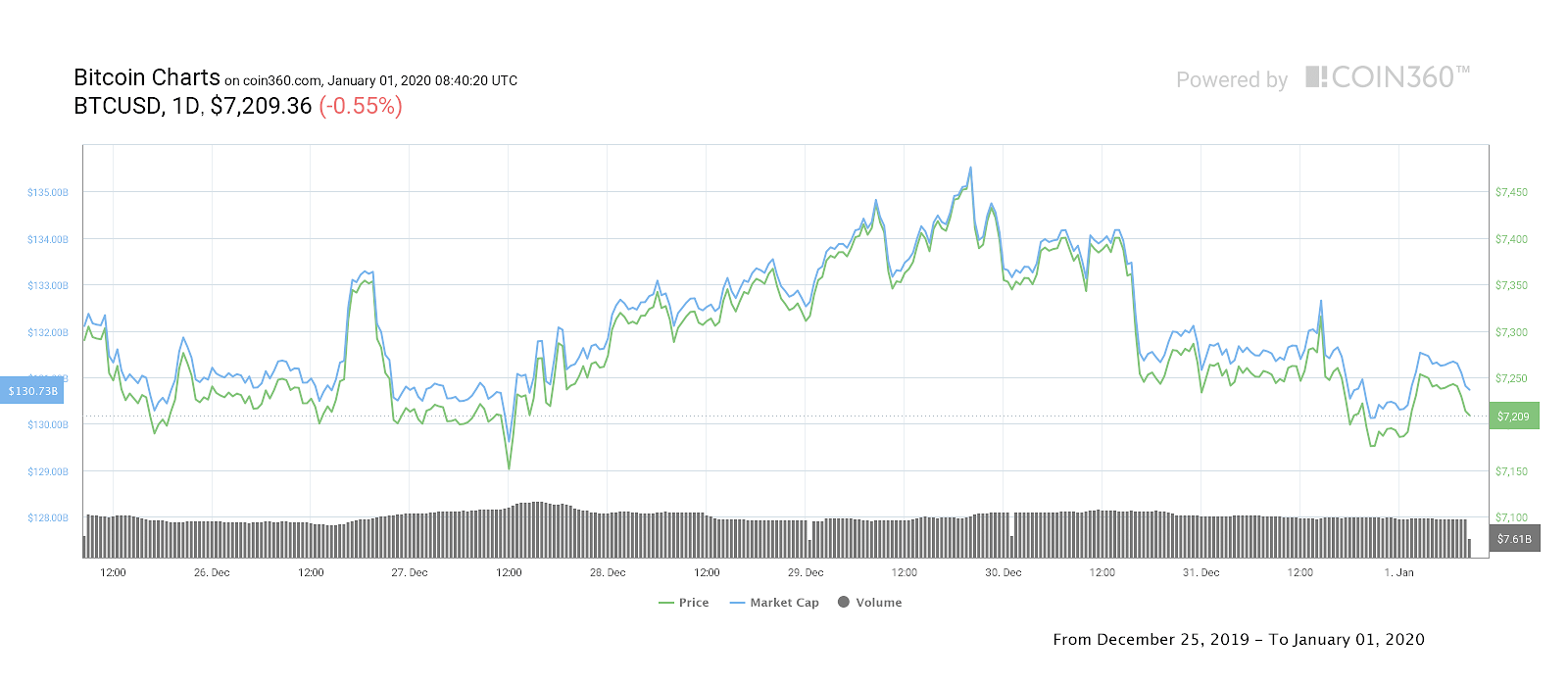
At press time, BTC/USD traded at just under $7,200, cementing a week in a narrow corridor between $7,090 and $7,495.

Bitcoin 7-day price chart. Source: Coin360

The slow yet choppy conditions follow a sudden breakdown in the third week of December, which saw the pair dip to its lowest levels in over seven months — around $6,460. 

Since then, Bitcoin has broadly coalesced around the $7,200 mark, with brief trips higher quickly reversing.

The status quo is likely to continue, analysts say, with the short-term prognosis for BTC/USD showing little signs of starting a new trend.

For regular Cointelegraph contributor Michaël van de Poppe, a turning point could come in February or slightly later.

“Still stuck within this range and I think we’ll stay here for the next month as well,” he summarized in his last Twitter update for 2019.

Van de Poppe continued: 

“Probably see a scenario something like this in which we first make a fake-out to either way to trap the market, before the decisive move occurs.”

For fellow contributor filbfilb, however, Bitcoin’s failure to crack resistance at $7,600 suggests a dip back into the $6,000 range. That event, he added in analysis for Cointelegraph on Dec. 30, should nonetheless not involve a lower bottom than that seen in December.

A more uplifting statistic meanwhile focuses on Bitcoin’s previous gains. In the ten years from 2010 to 2020, the largest cryptocurrency delivered 9,000,000% returns to investors. 

The impressive statistic came to light during an ongoing Twitter debate among commentators as to whether entrepreneur John McAfee will have to honor his pledge to consume his own penis if BTC/USD fails to reach $1 million by 2021. 

For reference, the gap between the current price and the seven-digit target is a comparatively doable 13,800%. 

A dedicated countdown tool, candidly titled “Dickening,” is keeping track of the odds.

Altcoins follow static sentiment

In line with Bitcoin, altcoins saw little change as the new year began, moving up or down by a maximum of around 2%.

Ether (ETH), the largest altcoin by market cap, traded down 1.5% to circle $130. 

Ethereum Classic 7-day price chart. Source: Coin360

Others made modest gains — XRP appreciated 1.1% and Bitcoin SV (BSV) 2.5%.

The overall cryptocurrency market cap was $191.2 billion at press time, with Bitcoin’s share at 68.2%.

Keep track of top crypto markets in real time here


from https://ift.tt/2QzTVux

Invest in These 2 Sectors Now — Don’t Wait for the New Year

Timor Invest

I have my sights set on two of the next big market trends in 2020.

In fact, I believe the untapped potential for massive gains in these sectors will pay out over the next decade!

It will shape the way we look at business, entertainment and the world as we know it.

You will not want to miss out on this opportunity come 2030.

Check out this week’s video to find out how your portfolio can dominate the next decade:

Investing in The Next Decade

Predictions for 2020 rely on an imagination of the future based in fact. This is the very last Bold Profits Daily of 2019. 2020 is just a few days away and with that begins not just a new year, but a new decade. And the ending of one decade has us thinking about the future – all the way towards 2030.

What will our world look like in 2030? What will you wish you invested in at the beginning of 2020 so when you look back in 2030 you can say, “Nobody was thinking about this and I bought it and made a lot of money.”

I have seen a few graphs now of what was popular 10 years ago and what was most valuable 10 years ago. It has been an extraordinary period of time. The amount of change, the rate of change and the impact of it has been mind-blowing.

Hindsight is 2020 – Winning Examples

John Maynard Keynes said interest rates are always above zero. He proved it with math. In hindsight, one of his errors was obvious.For example, in 2010, Amazon was a company that was largely considered an online retailer for books and CDs. In 2020, when you look at Amazon, it’s an enormous company that sells just about everything you want to buy. It also owns Whole Foods. It has the biggest cloud-computing platform in the world. And it’s getting into so many other businesses.

In 2010, Google was surrounded by competitors. In fact, most investors thought Google was too vulnerable. No one really thought it would be the kind of advertising powerhouse it has become today. It is now an enormous media company that completely dominates advertising.

Then there are companies that most people never imagined would be anything today. Who would have thought that Facebook or Netflix could completely change culture and fundamentally change the way we consume media.

Netflix is now beginning to disruptify the movie business, the TV business and is looking to capture all the market share it once had.

Facebook today, as a whole, has the Facebook platform, Instagram platform, Oculus platform and WhatsApp Platform— what will it usurp and take in the next 10 years?

Sectors to Watch Next Decade

I’ve discussed a bunch of predictions for 2020. When I look at it, I look and see two large places where I believe you are going to see a massive disruption.

Prediction 1: Finance

Invest in crypto. I recently tweeted that the next 10 years you will see cryptocurrencies, mortgage tech and insurance tech really creep into and then wipe out banks, insurance companies and mortgage finance companies as we know it.

invest in crypto Paul Mampilly tweet

This part of the market is horribly inefficient and horribly inconvenient. Consumers are charged lots of money and receive very little value. That’s why I tell investors who are looking to make smart long term investments in 2020 and beyond, look here. Invest  in cryptocurrencies, mortgage technology, insurance technology, financial technology in 2020. You’ll look back in 2030 and say “this was so obvious!”.

Invest in crypto and tech in general because they are going to take market share from banks and insurance companies that are, today, worth trillions of dollars.

Prediction 2: Manufacturing

The making of things is about to completely change. In fact, the changes have already started. Right now we still make things more or less the way we have made them for about 100 years. For sure, the Industrial Revolution completely automated manufacturing, but we still have to actually make them. We didn’t change the process.

However, when you think about technology like 3D printing, you can see that they can now print massive things. We can print everything from a toothbrush to airplane wing parts. You know that the world of manufacturing is just going to be completely and utterly disrupted.

The current, old world manufacturing system that we have counted on for 100 year, is coming to an end rapidly. We are entering the new world, manufacturing houses, furniture, cars, planes, everything will change. Investors who want to enter into this sector should look into industrial companies that are using and starting to implement new manufacturing technology.

3D printing, CAD CAM software, the Internet of Things… all manufacturing systems have existed on the outside on the periphery. Technology companies are going to enter the world of making things and I believe it’s going to be on sector that smart investors get into now.

Those are my predictions for 2020. Happy New Year to all of you, and happy investing.

Regards,

Paul Mampilly

Editor, Profits Unlimited


from https://ift.tt/37owQlh

2020 Forecast: The Big Picture Backdrop for Precious Metals


from Metals Analysis https://ift.tt/37pl7CR
via IFTTT

вторник, 31 декабря 2019 г.

Natural Gas Ends The Year On A Sour Note


from Metals Analysis https://ift.tt/2tiUfWE
via IFTTT

Ring in the New Year With a Tax-Free Passive Income Stream!

Timor Invest

What better way to ring in the New Year than with a gift that keeps on giving?

Over the holiday season, we typically spend more money than we had planned. Around New Year’s, we make resolutions to cut back. Then in the next year, the cycle repeats itself.

One great way to break the cycle is to give yourself the gift of tax-free income.

Thanks to the Tax-Free Savings Account (TFSA), it’s possible to buy investments without worrying about taxes. Similar to RRSPs, TFSAs give you tax-free growth. Unlike RRSPs, however, they also let you withdraw tax-free.

This makes the TFSA the perfect account to establish a tax-free income stream — one that can help you pay for the holidays next year without breaking the bank.

Investors can now contribute up to $69,500 to a TFSA

TFSA contribution room is cumulative, meaning that every year you get an additional amount of contribution space plus whatever you have left from past years.

In 2020, investors who were at least 18 in 2009 will have $69,500 worth of contribution space. At a 4% average yield, a portfolio of that size will produce $2,700 a year in dividend income–more than enough to cover the average Canadian family’s Christmas expenses.

A solid TFSA income pick

If you’re looking to establish your own TFSA income stream, a greater beginner pick would be the iShares S&P/TSX 60 Index Fund (TSX:XIU). As a diversified, low-fee index ETF, it gives you built-in diversification and spares you having to painstakingly research individual stocks.

Although XIU’s dividend yield (2.8%) isn’t quite enough to get the $2,700 a year in income mentioned above, it can produce a substantial amount in its own right (about $1,950 a year) with $69,500 invested.

More important, as an index fund, it’s not actively managed, which means that you’re guaranteed to replicate the performance of the target benchmark (the TSX 60) and will pay low fees.

Why recommend XIU as opposed to another Canadian index fund?

Personally, I favour XIU to XIC–the obvious runner-up–for a few reasons.

With its concentration on large caps, XIU has fewer high-risk components than does XIC.

As a more popular fund, it’s more liquid.

Finally, XIU has enjoyed slightly better performance than XIC historically. There’s no guarantee that that will remain the case, but it holds over a pretty long time frame.

If you wanted to diversify your TFSA ETF portfolio a little, I’d consider adding a U.S. fund like the Vanguard S&P 500 Index Fund, but I’m personally comfortable keeping my entire Canadian ETF portfolio in XIU.

Foolish takeaway

If the holiday season is about spending, then the New Year is about saving. After the gift giving bonanza of Christmas, New Year’s can be a great time to cut back on spending and get your finances in order.

One great way to do that is to hold income-producing investments in a TFSA and keep receiving tax-free gifts every quarter the whole year round.

5 TSX Stocks for Building Wealth After 50

BRAND NEW! For a limited time, The Motley Fool Canada is giving away an urgent new investment report outlining our 5 favourite stocks for investors over 50.

So if you’re looking to get your finances on track and you’re in or near retirement – we’ve got you covered!

You’re invited. Simply click the link below to discover all 5 shares we’re expressly recommending for INVESTORS 50 and OVER. To scoop up your FREE copy, simply click the link below right now. But you will want to hurry – this free report is available for a brief time only.

Click Here For Your Free Report!

Fool contributor Andrew Button owns shares of iSHARES SP TSX 60 INDEX FUND.


from https://ift.tt/36dXWex